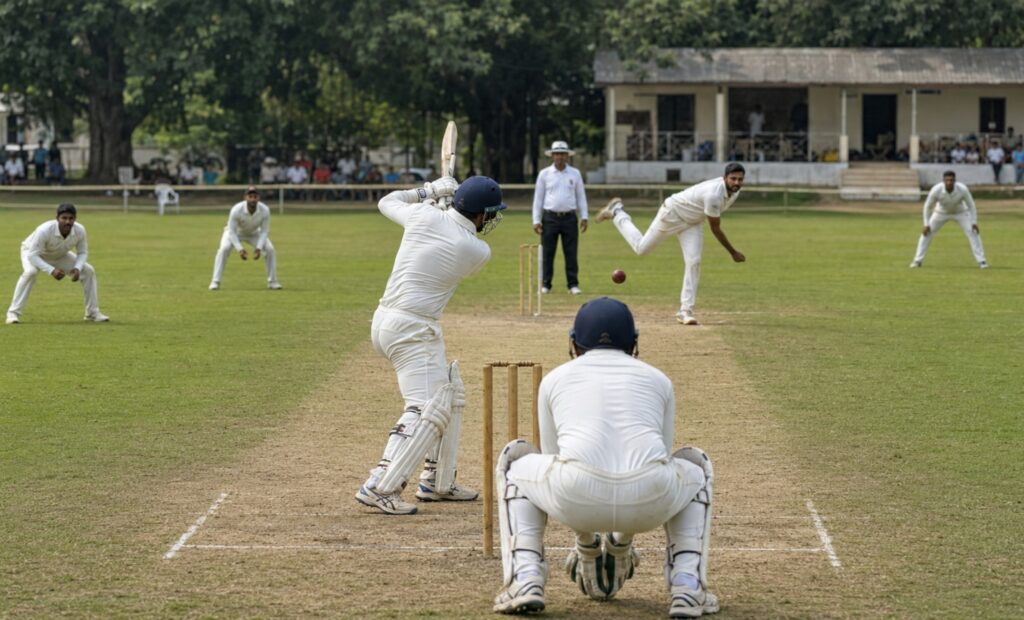
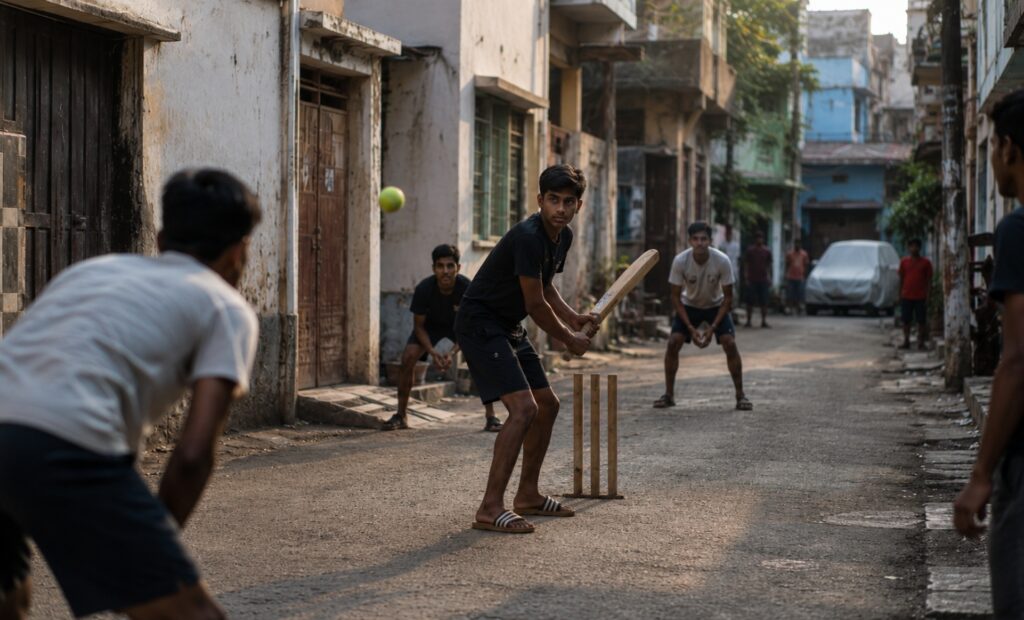
Every Indian cricketer, famous or forgotten, learned the game twice. Once from a coach, if they were lucky. And once, long before that, in a gully.
The gully is the lane behind your building, the empty plot near the temple, the stretch of road that goes quiet by evening. It has no scoreboard and no boundary rope. It has produced more love for cricket than every stadium in the country combined.
Gear Up For Your Next Run


One Tennis Ball, Twenty Kids, Zero Umpires
Picture the setup. A worn tennis ball, sometimes wrapped in electrical tape to make it swing. A bat that has been taped at the handle more than once. Three bricks for stumps, or a chalk rectangle on a wall.
Twenty kids show up and somehow eleven-a-side never happens. Teams are picked by age, by size, by who owns the bat. The youngest fields at the least dangerous spot. The oldest opens the batting and nobody argues, at least not yet.
There is no umpire. Every decision gets made by the players themselves, out loud, at volume.
And still the game runs for hours, day after day, summer after summer. That is the quiet miracle of gully cricket. A game with no authority that almost never falls apart.
The Rules Nobody Wrote Down
Gully cricket has laws, they are just not written anywhere. They pass from one batch of kids to the next like folklore, and they change from lane to lane.
One-tip-one-hand: catch it after a single bounce with one hand, and you are out. Over the wall on the full is out, because the neighbour will not return the ball. First-ball trial for the youngest, because fair is fair. The batsman who owns the bat gets the benefit of the doubt, because tomorrow you might need his bat again.
Each lane writes its own constitution. The kid who bats too long is told to retire so others get a turn. The tall boy who bowls too fast at the little ones gets a warning first, then loses his bowling.
These are not just rules about cricket. They are a childhood course in negotiation, fairness, and reading a room.
What the Gully Teaches That an Academy Cannot
A coaching manual will teach you the textbook cover drive. The gully teaches you something the manual leaves out: how to play the ball that was never supposed to happen.
The pitch is uneven, so the ball keeps low or leaps at your ribs. The tennis ball swings in ways a cricket ball never will. There is a car at short cover and an open drain at deep square leg, and both are in play. You learn to improvise because the alternative is getting out or getting hurt.
This is not a small thing. Some of India’s most technically sound batsmen came up through the streets and maidans of Mumbai. Sachin and Gavaskar both learned the game there, long before any academy touched it.
The street does not produce sloppy players. It produces adaptable ones, which is the more useful thing.
From the Gully to the Grandstand
The line from the street to the stadium is shorter than people think. Ask almost any India cricketer where they first held a bat, and the answer is rarely an academy.
When Sachin Tendulkar co-founded Ten x You as Co-founder and Chief Inspiration Officer, he spoke about exactly this. He has often reflected on the Harris Shield, the school tournament that launched his own career. Those early matches, he has said, taught him discipline, teamwork, and resilience, qualities that stayed with him for good.
The professional game is the visible tip. The gully and the maidan are the enormous, invisible base that holds it up.
That is the real cultural weight of gully cricket. It is not a lesser version of the real thing. It is the soil the real thing grows out of, renewed every generation by kids who have never heard of a selection trial.
The Shoe for Ground That Was Never Flat
Gully cricket is hard on feet in ways proper cricket is not. You pivot on concrete, sprint on gravel, stop short before a wall, and do it all in whatever shoes you own.
Real cricket footwear used to mean metal spikes, useless on a road and painful on tile. That gap is what the All-Rounder Cricket Shoe was built to close. Its full rubber studs grip hard ground, turf, and matting from a single shoe. The same pair works for the lane and the club match on Sunday.
At 370 g it is among the lightest cricket shoes going, which matters when a quick single is decided by half a step. The 70 mm ankle collar is one of the highest around, holding your ankle steady through the sharp turns that broken ground forces on you. The wide toe box is built for an Indian foot, not a Western last relabelled for Asia. It is available at ₹2,449 (MRP inc all taxes).
Why It Still Matters
You could argue gully cricket is fading, squeezed by traffic, by screens, by shrinking open space in growing cities. Some of that is true. Most of it misses the point.
The brand Sachin co-founded puts it plainly: sport does not belong only to stadiums, it belongs everywhere people choose to play. Gully cricket is that idea in its purest form. It moves to terraces, to parking lots, to whatever flat-ish surface a city leaves unguarded for an evening.
That resilience is the most Indian thing about it. Gully cricket does not need permission, funding, or a governing body. It needs a lane and some daylight, and India has always found a way to supply both.
Never Stop Playing
The next time you pass a gang of kids stopping traffic for a between-innings change of ends, slow down and watch for a minute. You are looking at the base of the whole pyramid, the place where the love starts.
Every stadium roar traces back to a lane like that one. If you want to feel part of that unbroken line, lace up a pair of performance shoes and find a game.
Never Stop Playing. Start here.